
These statements have not been evaluated by the Food and Drug Administration. These products are not intended to diagnose, treat, cure, or prevent any disease. For research use only.  Legal & Disclaimer

Regulatory note: Retatrutide was specifically cited in the Gram Peptides FDA Warning Letter (March 31, 2026 — MARCS-CMS 721806). All Sequence Labs retatrutide is supplied strictly for qualified research use only, with full Krause Analytical COA documentation on every batch.

GLP-1 / GIP / Glucagon Triple Agonist

Retatrutide
Research Compound

Synthetic peptide triagonist studied for simultaneous activation of GLP-1R, GIPR, and GCGR receptor pathways. Developed by Eli Lilly. Phase 3 TRIUMPH program ongoing. Supplied strictly for qualified research applications.

Triple Agonist Krause Analytical COA Sabrina Runbeck, PA-C Research Use Only 5mg – 40mg
Browse retatrutide publications on PubMed →
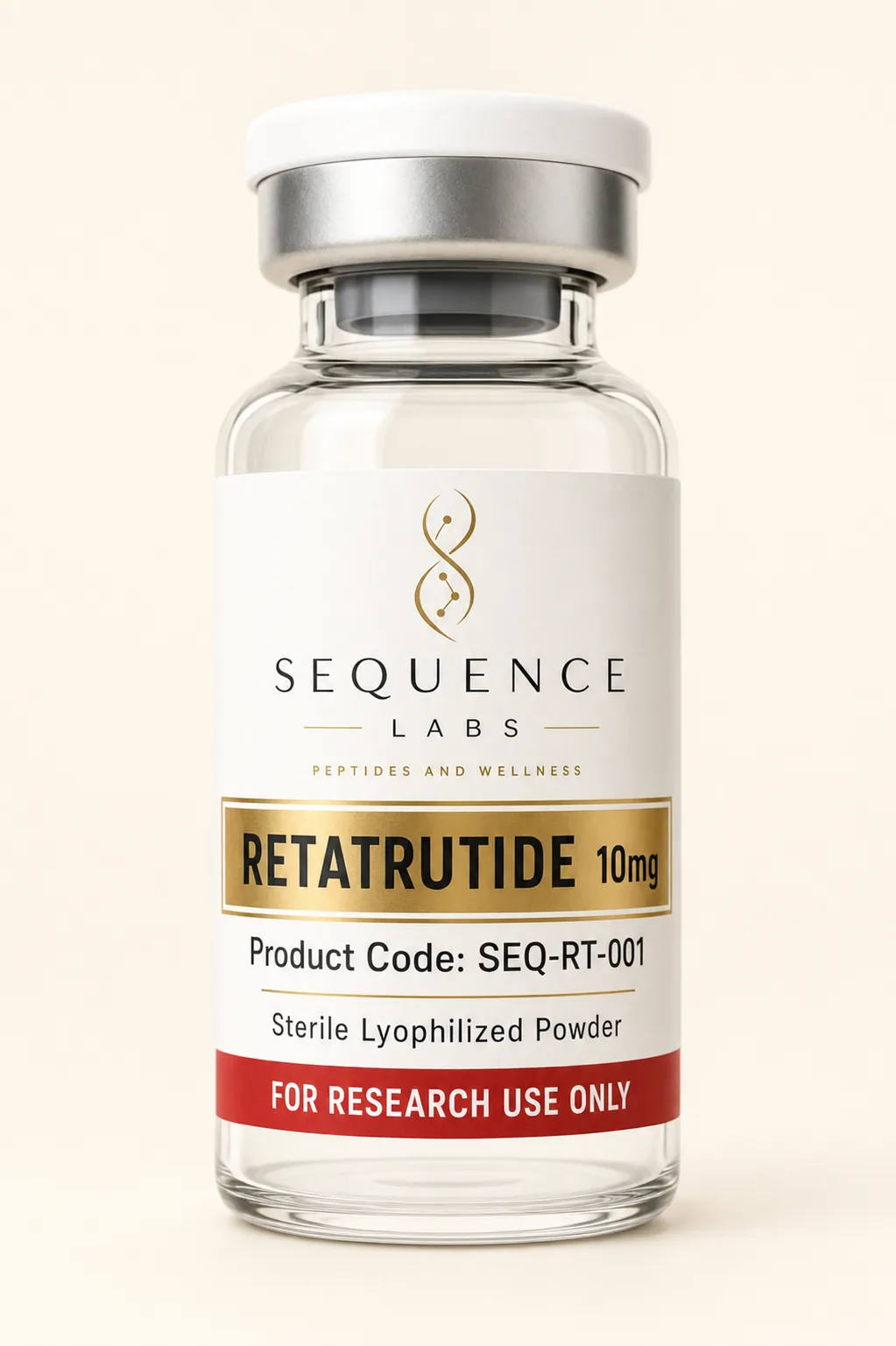
Retatrutide research vial — Sequence Labs
  • 5mg$66.99
  • 10mg$89.99
  • 15mg$108.99
  • 20mg$148.99
  • 30mg$198.99
  • 40mg$252.99

Compound Profile

What Is Retatrutide?

Retatrutide (LY3437943) is a synthetic acylated peptide developed by Eli Lilly & Company. It is structurally engineered to function as a simultaneous agonist at three incretin and glucagon-related G protein-coupled receptors. Published research has investigated its multi-receptor pharmacology across the Phase 1 and Phase 2 TRIUMPH trial program, with Phase 3 data ongoing as of 2026.

Classification
Triple Incretin Receptor Agonist
Simultaneously targets GLP-1R, GIPR, and GCGR — the first compound in this mechanistic class to reach Phase 3 clinical investigation.
Structure
Acylated Synthetic Peptide
Single continuous helical structure. N-terminal segment engages receptor transmembrane domains; C-terminal segment interacts with extracellular binding regions of GLP-1R and GIPR.
Developer
Eli Lilly & Company
Phase 3 TRIUMPH program ongoing. Investigational — not FDA-approved. Distinct from tirzepatide (Mounjaro/Zepbound), which is a dual GLP-1R/GIPR agonist.
Half-Life
~6 Days
Dose-dependent pharmacokinetics. Primarily hepatic metabolism. Published research documents no significant cytochrome P450 enzyme interaction.
Receptor Potency (EC₅₀)
GIPR > GLP-1R > GCGR
Published EC₅₀ values: GIPR ≈ 0.064 nM · GLP-1R ≈ 0.775 nM · GCGR ≈ 5.79 nM. Highest agonist potency at the GIP receptor axis.
Research Status
Phase 3 (Investigational)
Cannot be compounded under current FDA guidance. Supplied by Sequence Labs strictly for qualified research use. Not intended for human use.

Mechanistic Context

Retatrutide vs. Tirzepatide vs. Semaglutide — Receptor Targets

Peer-reviewed literature has investigated retatrutide's distinct receptor profile relative to earlier incretin compounds. The glucagon receptor axis — absent from both semaglutide and tirzepatide — represents the mechanistically novel dimension of published retatrutide research.

Receptor Target Semaglutide
GLP-1 monoagonist
Tirzepatide
GLP-1/GIP dual
Retatrutide
GLP-1/GIP/GCG triple
GLP-1 Receptor (GLP-1R) Primary target Active Active (EC₅₀ ≈ 0.775 nM)
GIP Receptor (GIPR) Not targeted Active Highest potency (EC₅₀ ≈ 0.064 nM)
Glucagon Receptor (GCGR) Not targeted Not targeted Active (EC₅₀ ≈ 5.79 nM)
Hepatic Glucagon Receptor Signaling Investigated in liver oxidation pathway research
Phase 3 Trial Program FDA approved (Ozempic/Wegovy) FDA approved (Mounjaro/Zepbound) Ongoing (TRIUMPH program)
Compoundable Under FDA Guidance When shortage-listed When shortage-listed Investigational drug — not compoundable

Published Research Areas

Active Areas of Retatrutide Investigation

Peer-reviewed literature has examined retatrutide across several intersecting pharmacological domains. The following areas reflect published research contexts — not claims about outcomes or human effects.

Triple Incretin Receptor Pharmacology
Published research has examined the simultaneous binding kinetics of a single peptide across three structurally related but distinct G protein-coupled receptors (GLP-1R, GIPR, GCGR) — a mechanistic framework not previously characterized in an approved compound.
Glucagon Receptor Signaling Pathways
Research has investigated how glucagon receptor activation — absent from semaglutide and tirzepatide — modulates hepatic lipid oxidation, mitochondrial oxidative stress markers, and bile acid profiles in preclinical and Phase 2 contexts.
Multi-Receptor Agonism Mechanisms
Structural biology research has examined how retatrutide's continuous helical architecture enables differential engagement across three receptor transmembrane domains from a single molecular scaffold — a model of multi-target peptide design.
Energy Expenditure Pathway Research
Preclinical and clinical trial literature has examined the intersection of GLP-1R, GIPR, and GCGR co-activation on thermogenic and metabolic pathway signaling, particularly in contexts where glucagon receptor engagement may modulate energy substrate utilization.
Hepatic Lipid Research
Published research — including American Diabetes Association presentations — has examined retatrutide's glucagon receptor component in the context of hepatic steatosis, oxidative stress, and fibrotic pathway modulation, leveraging the liver's high GCGR expression.
Novel GLP-1 Class Mechanisms
Retatrutide represents the first triagonist compound to reach Phase 3 investigation, making it a reference model for researchers studying how incremental receptor additions alter the pharmacological profile of GLP-1 class peptide structures.
Search retatrutide on PubMed →
Purity & Authenticity Alert — Retatrutide

Independent testing has identified retatrutide as among the highest-risk compounds for adulteration and substitution in the research peptide market. Third-party testing of Peptide Sciences samples by Janoshik Analytical — conducted between late 2024 and early 2026 — detected quality inconsistencies and at least one confirmed counterfeit in their retatrutide inventory. Retatrutide was also specifically named in the FDA Warning Letter issued to Gram Peptides (March 31, 2026). Sequence Labs supplies retatrutide exclusively with batch-specific COA documentation from Krause Analytical (Austin, TX) — independent HPLC and mass spectrometry identity and purity verification on every lot. Verify any batch at any time via our COA Library.

Sequence Labs Supply

Research-Grade Retatrutide.
COA on Every Batch.

Given the heightened regulatory and purity scrutiny around retatrutide, Sequence Labs holds every lot to a higher documentation standard. All retatrutide is independently verified by Krause Analytical before release — with HPLC purity, mass spectrometry identity confirmation, and batch traceability published in the COA Library.

≥99%
Verified purity — HPLC confirmed
MS ID
Mass spec identity on every batch
Krause
Krause Analytical — Austin, TX
PA-C
Licensed PA-C catalog review
Public
COA Library — open, searchable
5mg$66.99
10mg$89.99
15mg$108.99
20mg$148.99
30mg$198.99
40mg$252.99

Reconstitution Reference

Research Sample Preparation

Standard lyophilized peptide preparation protocol for laboratory use. All steps are for qualified research preparation only.

01
Allow to Equilibrate
Allow the sealed vial to reach room temperature before opening. This minimizes condensation that can affect lyophilized peptide integrity during preparation.
02
Introduce Solvent
Introduce bacteriostatic water or sterile water for research purposes slowly along the interior vial wall. Avoid directing solvent stream directly onto the lyophilized cake to preserve peptide structure during dissolution.
03
Gentle Agitation
Roll the vial gently between fingers to facilitate complete dissolution. Do not vortex or shake vigorously — peptide bonds can degrade under high mechanical stress during reconstitution.
04
Visual Inspection
Verify complete dissolution and visual clarity of the reconstituted research preparation before proceeding. Any particulate matter or turbidity should be documented and the preparation evaluated.
05
Storage
Lyophilized: store at −20°C. Once reconstituted, refrigerate at 2–8°C and use within the timeframe appropriate to your laboratory protocol. Minimize freeze-thaw cycling.

For research use only. Not for human use or veterinary use. These preparation notes are provided as a general laboratory reference and do not constitute instructions for human administration. Retatrutide is an investigational compound that has not received FDA approval for any indication.

Frequently Asked Questions

Retatrutide is a synthetic peptide engineered to activate three distinct G protein-coupled receptors simultaneously: the GLP-1 receptor (GLP-1R), the glucose-dependent insulinotropic polypeptide receptor (GIPR), and the glucagon receptor (GCGR). Its continuous helical molecular architecture allows the N-terminal segment to traverse each receptor's transmembrane domain, while the C-terminal segment engages extracellular binding regions. Published research documents differential potency across the three receptors, with EC₅₀ values of approximately 0.064 nM at GIPR, 0.775 nM at GLP-1R, and 5.79 nM at GCGR — making it the highest-potency GIPR agonist in its class by current published data.
Semaglutide is a GLP-1R monoagonist. Tirzepatide adds GIPR co-agonism to the GLP-1R framework, producing the dual mechanism investigated in the SURMOUNT trial program. Retatrutide further extends this by adding glucagon receptor (GCGR) agonism — a third axis not present in either earlier compound. Glucagon receptor signaling has been studied independently for its roles in hepatic lipid oxidation pathways, mitochondrial stress modulation, and bile acid regulation. The liver — rich in GCGR but lacking GLP-1R and GIPR — is therefore accessible to retatrutide's pharmacological profile in ways that semaglutide and tirzepatide are not. This represents the core mechanistic distinction that has driven published research interest in retatrutide as a separate investigational model.
Retatrutide is among the most frequently flagged compounds for purity and identity failures in third-party testing. Janoshik Analytical's independent testing of Peptide Sciences samples collected between late 2024 and early 2026 detected quality inconsistencies and at least one counterfeit result in their retatrutide inventory — a finding consistent with the broader regulatory environment in which retatrutide was specifically named in the Gram Peptides FDA Warning Letter (March 31, 2026, MARCS-CMS 721806). The risk of researchers working with mislabeled, diluted, or substituted material is higher for retatrutide than for most other research peptides. Sequence Labs supplies retatrutide exclusively with batch-specific COA documentation from Krause Analytical (Austin, TX), providing HPLC purity and mass spectrometry identity confirmation on every lot — verifiable through the public COA Library.
Sequence Labs stocks retatrutide research vials in six sizes: 5mg ($66.99), 10mg ($89.99), 15mg ($108.99), 20mg ($148.99), 30mg ($198.99), and 40mg ($252.99). All sizes are batch-tested by Krause Analytical with batch-specific COAs accessible through the COA Library. For researchers requiring quantities not listed, contact Team@SequenceLabs.Health to discuss availability.
Yes. Licensed research institutions, medical practices, medical spas, and qualified wholesale accounts can access tiered B2B pricing on retatrutide and across the Sequence Labs catalog. Wholesale tiers range from approximately 18% to 32% below retail based on per-order volume, with no monthly commitment requirements. Apply via the Wholesale page or contact Team@SequenceLabs.Health directly for volume inquiries.

Ready to Source Research-Grade Retatrutide?

Every batch independently verified by Krause Analytical. HPLC + mass spec COA published for each lot. For qualified researchers and licensed professionals only.